

Personal AI Agents (Meta Muse, OpenAI dots) Are Visiting Your Website: What to Change in robots.txt, SEO and Analytics
- October 26, 2026
- Blogs
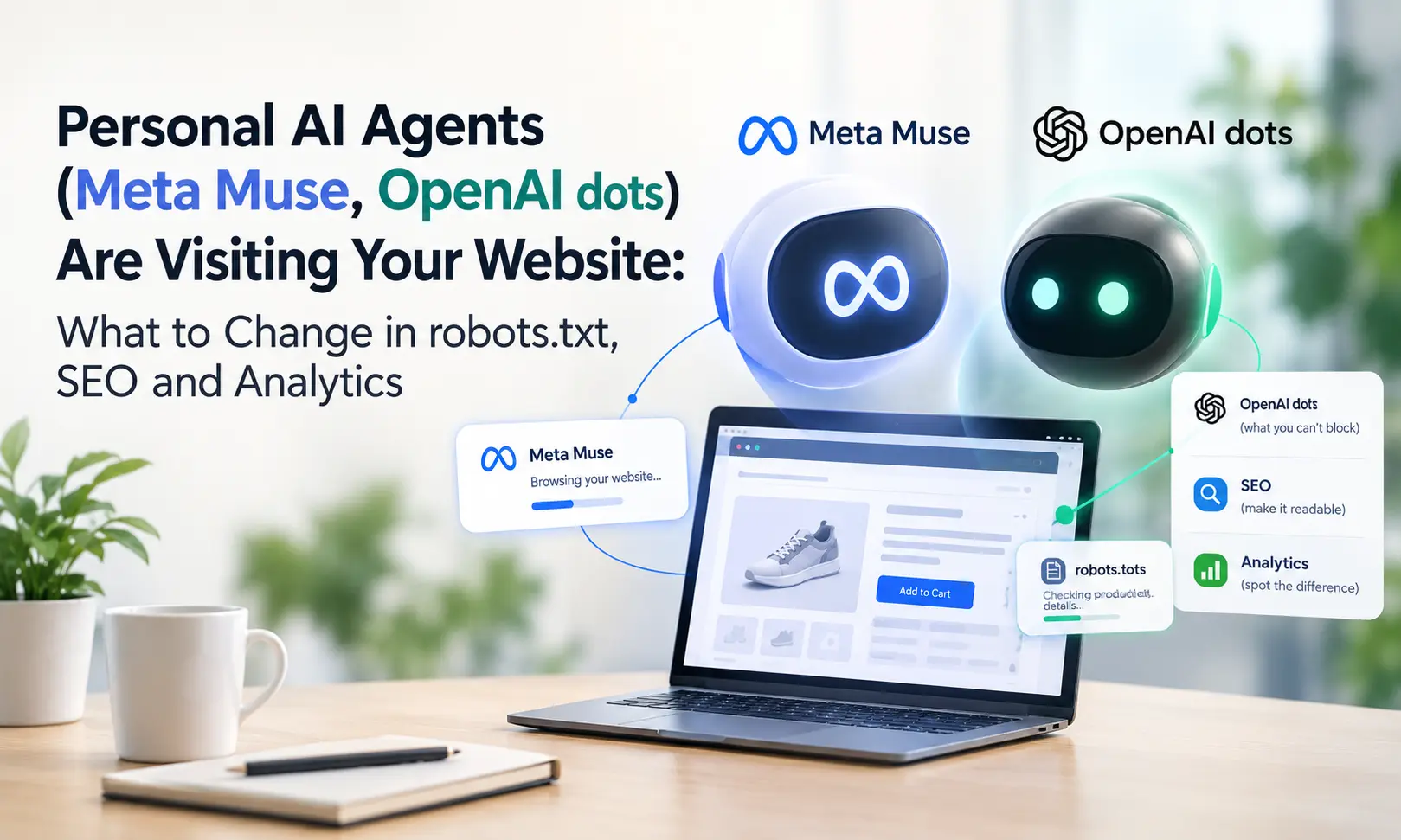
Personal AI agents like Meta Muse and OpenAI dots are changing how websites are accessed, making SEO, accessibility, and analytics more important.
Open your analytics tomorrow and look at yesterday’s visitors. Some of them weren’t people. They were agents, working for people, and your reports almost certainly counted them as people anyway.
That’s the strange thing about Meta’s Muse and OpenAI’s dots. Muse launched in the US on September 8, 2026, and runs on a dedicated cloud machine with its own browser. Dots arrived on September 29 at DevDay, each with its own cloud computer and browser, and access to more than 4,000 apps through plugins. Both do errands: research a product, fill in a form, sometimes pay. And Meta says plainly that when Muse browses, it shows up as the user’s own activity.
Robots.txt can’t help you here
I’ll say the blunt version first. You can’t write a robots.txt rule for these two, because there’s nothing to write.
Neither Meta nor OpenAI has published a user agent, request header or signature for the Muse or dots browsers. Meta’s crawler page lists five bots, and Muse isn’t one. OpenAI’s lists four, and dots aren’t there either. Robots.txt has only ever worked by name, and it was always a polite request anyway, not a lock.
Amazon ran into exactly this. Its robots.txt refuses 99 named agents, and Muse isn’t among them, because there’s no name to use. So when it wanted Muse out, it went through its Conditions of Use instead. And OpenAI’s help pages tell dots users that if a site blocks the cloud browser, they can ask the dot to work through their own connected computer. So even a block that works may only redirect the visit.
What I’d actually do with the file:
-
- Leave it for crawlers. Decide on Meta-ExternalAgent (training) and Meta-WebIndexer (it feeds Meta AI search, so allowing it helps you get cited) like any other bot.
-
- Remember Meta-ExternalFetcher, which fetches links at a user’s request and may ignore the file.
-
- Ignore the “muse-” token a couple of guides mention. I couldn’t find it in Meta’s own documentation, and I wouldn’t build anything on it.
The real control is somewhere else: your terms of service, and whatever bot protection sits in front of your site. That’s often a security or platform team’s call, so get SEO into that conversation. Ask your vendor if it can tell a person’s Chromium from an agent’s. HUMAN Security says it can spot Muse.
Fix the page, not the file
Here’s where I think the real work is, and it’s less glamorous than people want it to be.
Meta says Muse’s browsing sub-agent reads an accessibility tree, the same structure screen readers use, not the raw page code, and can’t run JavaScript inside the page. OpenAI hasn’t said how dots read pages. Google’s own guidance for browser agents lists screenshots, the DOM and the accessibility tree.
So an agent is closer to a screen reader than to Googlebot. Slobodan Manić, in Search Engine Journal, found a clean example on a real Shopify store. Six of seven shoe sizes were sold out. Shoppers saw them greyed and crossed out. The accessibility tree showed seven identical buttons, nothing marked unavailable. A person sees that at a glance. An agent has to click each size to find out.
Which tells you what to check:
-
- Headings in real heading tags, in order
-
- Link text that names the destination
-
- Alt text on product images
-
- Prices and stock status in actual text, not an image or a styled colour
-
- Labels on every button and form field, including the icon-only ones
Structured data deserves a second look, too. Chrome keeps script blocks out of the accessibility tree, so JSON-LD may never reach a browsing agent. Keep it for Google. Say the same things in visible text.
You can see this yourself in about ten minutes. In Chrome DevTools, open Elements, then Accessibility, and turn on the accessibility tree.
I’d also skip llms.txt and markdown copies for this particular purpose. Neither company says its agent reads them, and an agent that came to check out needs buttons, not a summary.
Your analytics will lie a little
Here’s the honest state of things. Agent traffic reaches your reports in three ways, and only one is easy to see.
An in-app purchase never loads your pages, so your tags and pixels never run. The order exists in your platform records and nowhere else. A link from an AI app shows up as a visit, labelled by referrer if the app sends one, which is how GA4’s AI Assistant channel (added May 13) works. And an agent browsing your site directly? It looks like your customer, because there’s no published referrer or IP range to separate it out. Shopify even says its bot filtering errs toward counting visitors as human.
I haven’t found anyone who has published logs showing how GA4 or other filters label these sessions, and no one has published how many orders agents complete. Search Engine Journal cites a report of more than 3 million weekly Muse users, but that’s a count of users, not of site visits. I’d be wary of anyone selling certainty here.
So keep it simple: once a month, compare platform orders with analytics sessions, and note your launch dates on the chart. A widening gap is your first clue.
This week
Check whether your platform quietly enrolled you in an agent shopping channel. Sit down with whoever owns bot protection. Run the accessibility-tree test on your product and checkout pages. Move anything that lives only in structured data or images into text.
Conclusion
Personal agents like Muse and dots won’t wait for your website to be ready. They’re already browsing, comparing and, in some cases, buying for real customers, and the usual controls only partly reach them. Robots.txt has no name to act on. Your analytics may count an agent as a person. And a page that looks fine to a shopper can look like a row of identical, unlabeled buttons to an agent.
None of that is a reason to panic, but it is a reason to act. Start with the pages where people buy, book or enquire. Make the facts visible as text, label every button and field, decide on purpose how your bot protection treats agents, and check your orders against your sessions each month. These are small, practical fixes, and they also help your human visitors and your Google rankings.
Doing it well takes SEO, development, and analytics working together, which is hard for a small team to juggle. If you’d like a hand, that’s what we do at Mindstory, a digital marketing agency in Kerala based in Thrissur. Our team covers SEO, web development, performance marketing and analytics, so one team can audit the pages, tidy the tracking and tell you what the numbers actually mean.
Want your website checked for the agent era? Request a free quote at mindstory.in/. Tell us what you sell, and we’ll tell you where to start.
About us
We are Mindstory, Digital marketing company. We design thoughtful digital experiences and beautiful brand aesthetics.
Request a free quote
We offer professional SEO services that help websites increase their organic search score drastically in order to compete for the highest rankings even when it comes to highly competitive keywords.
More from our blog
View all stories

Personal AI Agents (Meta Muse, OpenAI dots) Are Visiting Your Website: What to Change in robots.txt, SEO and Analytics 3
Personal AI Agents (Meta Muse, OpenAI dots) Are Visiting Your Website: What to Change in robots.txt, SEO and Analytics 4